Proudly serving Mesa, Gilbert, Chandler, Tempe, Queen Creek, Scottsdale & surrounding areasCall or Text 24/7: 602-559-1623
Aerial drone photo of residential neighborhoods and desert vegetation in Mesa, AZ.

EV Charger Panel Upgrades in Mesa, AZ to Support High-Capacity Level 2 Charging Stations

Mesa EV Chargers provides EV charger panel upgrades, dedicated circuits, and charger installation in Mesa, AZ. We install Tesla Wall Connectors and NEMA 14-50 outlets, matching the charging equipment to your property's electrical capacity. Our work also includes charger repair, replacement, and commercial and fleet charging infrastructure.

A charger adds sustained demand to a home already running air conditioning, kitchen appliances, and other equipment. Older electrical panels may lack the capacity or breaker space for that additional load. We calculate your existing demand before recommending an upgrade, then handle the permit and inspection process. Contact us to review your service before buying charging equipment.

Our crews are licensed through the Arizona Registrar of Contractors and have manufacturer training for the equipment we install. We coordinate service-capacity questions with Salt River Project and APS when utility involvement is needed.

Mesa EV Chargers provides EV charger panel upgrades across Mesa and the East Valley, including Tempe, Chandler, Gilbert, Queen Creek, and Apache Junction.

★ ★ ★ ★ ★4.9/5 Customer Rating · 19 Years of Electrical Experience · 2,000+ Charging Projects Completed · Licensed, Bonded & Insured · Serving Homes, Fleets & Businesses

EV Charger Panel Options & Benefits

What Does an EV Charger Panel Upgrade Involve?

An EV charger panel upgrade addresses an electrical service that cannot support the added charging load. Depending on the property, the work may replace the main breaker and panel enclosure, with changes to the meter socket or service entrance conductors when needed. We assess the existing equipment before defining that scope.

Mesa homes built before the mid-1990s often have 100 amp or 125 amp main panels. A 40 or 50 amp charging circuit can add substantial demand alongside a pool pump, dual-zone AC, and an electric range. Homes ranging from 1970s ranch houses in Dobson Ranch to newer Eastmark properties need an individual capacity review.

Available amperage and available breaker slots are separate questions. If the main service has capacity but the enclosure is full, a subpanel may address the space issue. When the load calculation shows insufficient service capacity, adding more breaker positions alone does not solve the problem.

Benefits of Planning the Panel and Charger Together

A coordinated electrical plan matches the charger to the home and accounts for future needs. It also clarifies which work belongs in the panel, along the circuit route, and at the charging location.

  • Documented capacity review before equipment selection
  • Dedicated charging circuit without shared appliance loads
  • Breaker space matched to the proposed EV connection
  • Conductor sizing that accounts for installation conditions
  • Room to plan for a second EV or solar integration
  • Permit filing and inspection scheduling handled together
  • Charging output tested before project completion
  • Itemized labor and material costs for the proposed work
From Panel to Parking Space

Panel Upgrades and EV Charging Services

We handle the electrical work between your service entrance and charging location, from resolving a capacity shortage to connecting the charger. The scope can include a new dedicated circuit, hardwired equipment, a plug-in outlet, or infrastructure for multiple vehicles.

Main Panel and Service Upgrades

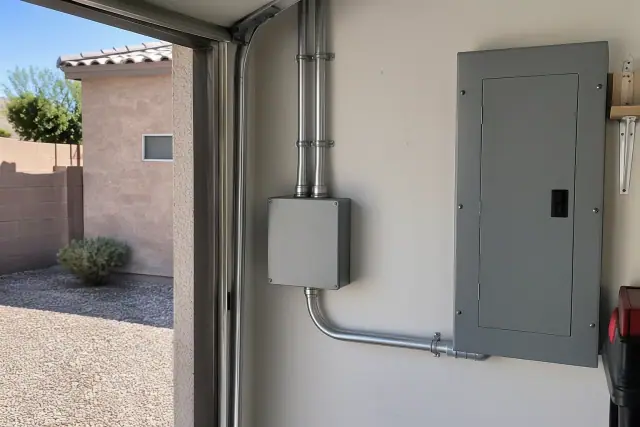
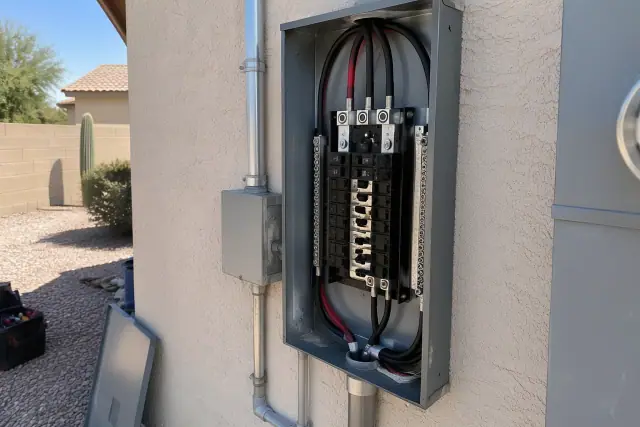
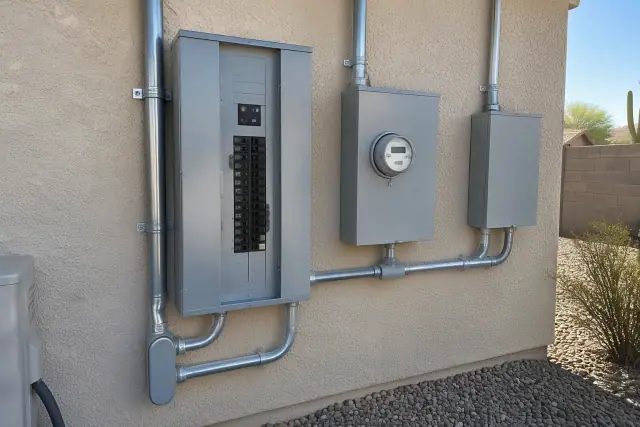
Main electrical panel and service upgrade on a stucco exterior wall in Mesa, AZ.

We evaluate the main panel, service rating, meter socket, and entrance conductors as a complete installation. A 200 amp service upgrade can accommodate a 60 amp EV circuit alongside household loads when the calculation supports it. We confirm the required capacity for your property before recommending replacement equipment.

Request Estimate

Dedicated EV Charging Circuits

Residential EV charger panel upgrade with metal conduit in Mesa, AZ.

Your charger receives its own breaker and conductors without sharing the circuit with other outlets or fixtures. Residential charger demand ranges from 24 amps for lighter Level 2 units to 48 amps for higher-output equipment. We match the circuit to the actual charging draw and continuous-load requirements.

Request Estimate

Tesla Wall Connector Installation

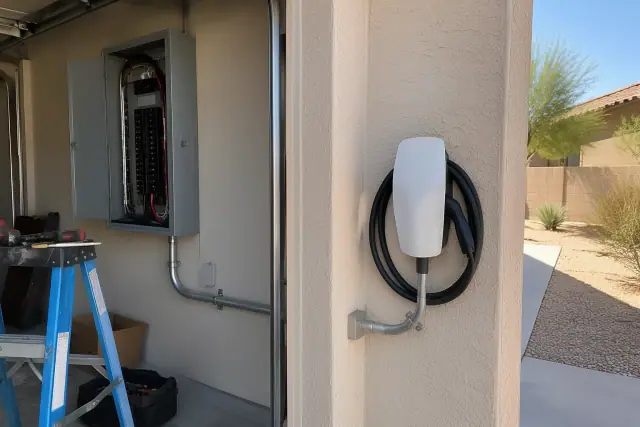
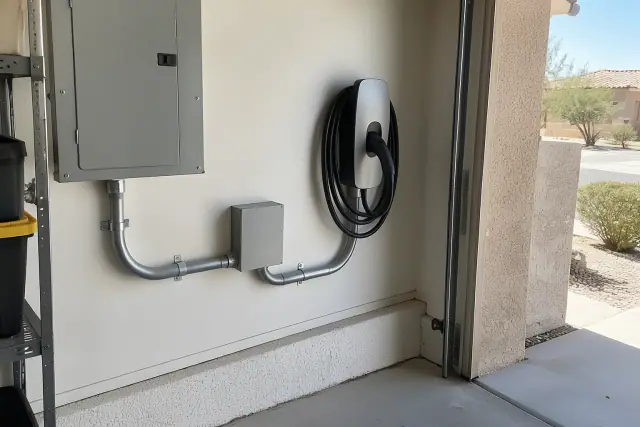
Tesla Wall Connector EV charger installation on a stucco home exterior in Mesa, AZ.

We install hardwired Tesla Wall Connectors after checking panel capacity and the circuit route. The Wall Connector supports up to 48 amps of continuous charging on a properly rated 60 amp dedicated circuit. Connections follow manufacturer torque specifications, and charging output is checked with a load meter.

Request Estimate

NEMA 14-50 Outlet Installation

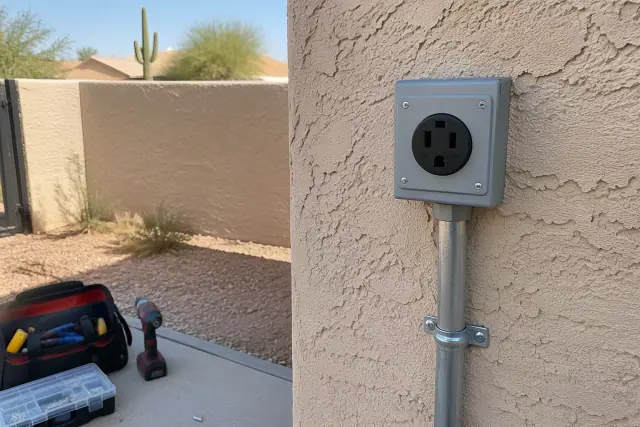
NEMA 14-50 EV charger outlet installed on a stucco exterior wall in Mesa, AZ.

A NEMA 14-50 outlet provides a plug-in option for compatible portable charging equipment. Most installations on an existing panel with available capacity are completed in a single visit, including the circuit run, outlet mounting, permit paperwork, and inspection scheduling. Outdoor installations receive a weatherproof, in-use cover.

Request Estimate

Commercial, Fleet, and Multifamily Charging

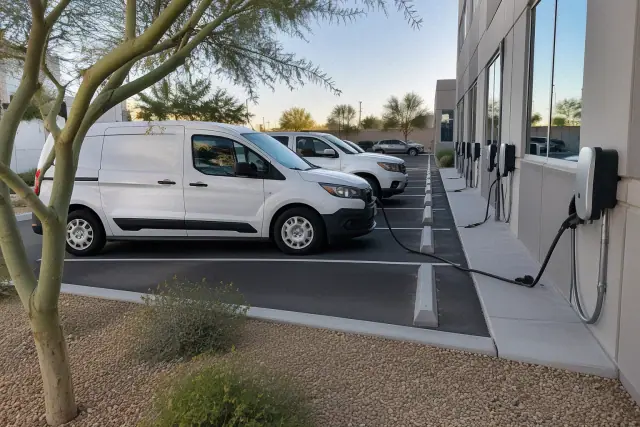
Wall-mounted commercial EV chargers in a Mesa, AZ office parking lot with a fleet van plugged in.

We plan fleet charging around vehicle return schedules and duty cycles, often using three-phase service and managed charging across multiple ports. Apartment and condo projects can include submetering and cost-allocation planning with property management. Commercial layouts also address accessible parking, charger reach, disconnects, signage, and future expansion.

Request Estimate

Charger Repair and Replacement

Technician working on EV charger panel upgrades inside a residential garage in Mesa, AZ.

We troubleshoot failed charging sessions, intermittent connection faults, and breaker trips before recommending replacement. A charger under five years old with a wiring or connection fault is often a repair candidate. Existing circuits and permit history are reviewed before reconnecting replacement equipment.

Request Estimate
Capacity, Connection, and Future Demand

Choosing Your Panel and Charging Options

The right configuration depends on available service capacity, physical breaker space, the charger connection, and how many vehicles need power. These options address different needs and can be combined when the load calculation and site layout support them.

Main electrical panel replacement on a stucco home with desert landscaping in Mesa, AZ.

Full Main Panel Replacement

A full replacement addresses a panel that has insufficient capacity as well as equipment that needs upgrading. We review the complete service so the proposed panel is appropriate for charging, cooling, and other household demand.

  • Main breaker and enclosure replacement
  • Meter socket review for the proposed service
  • Service entrance conductor assessment
  • HVAC and appliance loads included in the calculation
  • Utility capacity review when the existing supply is insufficient
Request Estimate
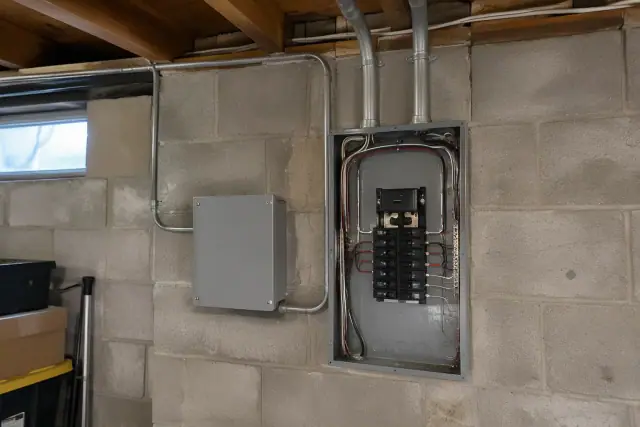
EV charger subpanel mounted on a basement wall in Mesa, AZ.

Subpanel for Additional Breaker Space

A subpanel can provide space for an EV circuit when the main service still has amperage headroom. We compare this approach with a permitted tandem-breaker arrangement or main panel replacement rather than assuming a crowded enclosure always needs a service upgrade.

  • Existing service capacity confirmed first
  • Physical breaker positions reviewed separately
  • Busbar rating included in the assessment
  • Tandem breakers considered only where allowed
  • Dedicated space for the proposed charging circuit
Request Estimate
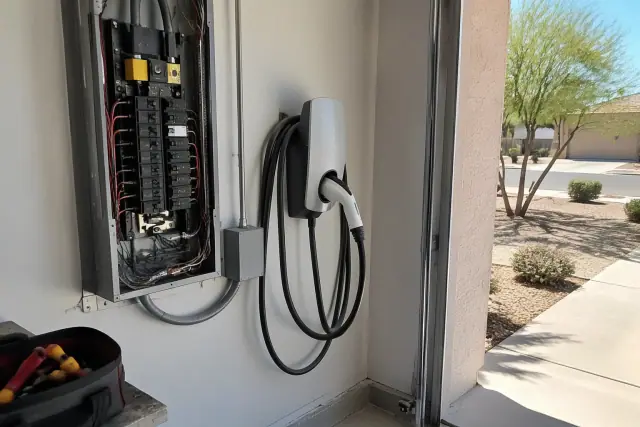
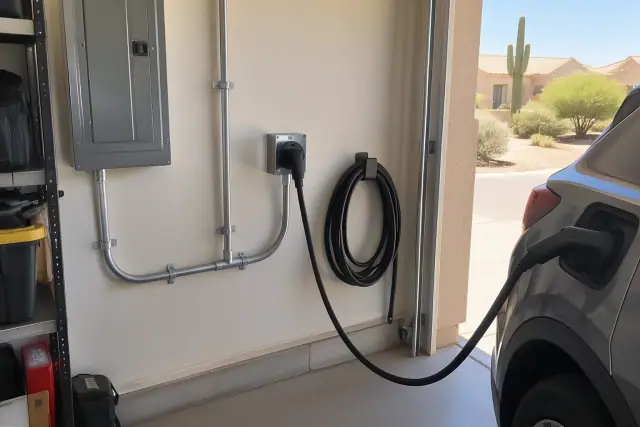
Hardwired Level 2 EV charger panel upgrade in a residential garage in Mesa, AZ.

Hardwired Level 2 Charging

Hardwired equipment connects directly to its dedicated circuit. We match the charging output to the vehicle and home, then assess the mounting location and exposure before selecting the installation details.

  • Direct connection at the charger
  • Manufacturer torque specifications followed
  • Panel-to-charger route planned before installation
  • Outdoor exposure considered for equipment placement
  • Load-meter verification of charging output
Request Estimate
NEMA 14-50 EV charger outlet mounted on a residential garage wall in Mesa, AZ.

Plug-In Charging with a NEMA 14-50 Outlet

A compatible plug-in charger can make equipment changes easier for households that expect to switch vehicles or charging units. We confirm the cord, outlet, and charging equipment work together before selecting this connection.

  • Portable charging equipment compatibility checked
  • Dedicated circuit from the electrical panel
  • Outlet mounting planned around the charging location
  • Weatherproof in-use cover for outdoor installations
  • Required GFCI protection reviewed for the equipment
Request Estimate
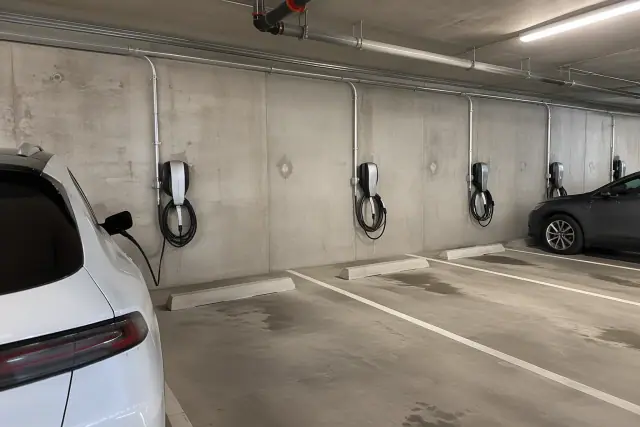
EV charger panel upgrades in an underground parking garage in Mesa, AZ.

Managed Charging for Multiple Vehicles

Fleet, workplace, and multifamily projects need a plan for several vehicles sharing the building's available electrical capacity. We organize charging around operating needs and consider future ports while planning the initial infrastructure.

  • Vehicle return schedules and duty cycles reviewed
  • Charging demand coordinated across multiple ports
  • Submetering considered for apartment and condo parking
  • Property management involved in cost allocation
  • Expansion planned to reduce repeat trenching
Request Estimate
A Recommendation Based on Your Property

Choosing the Right Electrical Approach

We separate a shortage of amperage from a shortage of breaker space, then compare the work needed for your charging goals. You receive an explanation of the capacity findings, installation route, and project costs before choosing an approach.

Documented Load Calculations

We use NEC 220 methodology to account for existing demand and apply the 125 percent continuous-load factor to the charger's rated amperage. EV equipment planning follows Article 625. The recommendation comes from the calculation, not the number of empty slots in the panel.

Permit and Utility Coordination

We handle applications and inspection scheduling with the City of Mesa Building Safety Division. When service capacity is in question, we coordinate with APS or Salt River Project early so meter or transformer review can be included in the project plan.

Itemized Installation Quotes

Quotes identify labor and materials for the actual route and equipment. Conductor length, conduit type, wall penetrations, trenching, and indoor or outdoor placement all affect the scope. We explain how a straightforward circuit installation differs from a service upgrade paired with a charger.

Find the Cause Before Choosing the Fix

Panel and Charging Problems We Resolve

A charging fault can start at the panel, along the circuit, or inside the equipment. We review the symptoms and test the installation so the recommendation addresses the underlying issue.

Request a Panel Assessment

Breakers Trip When Charging and Cooling Overlap

Simultaneous AC and EV charging can expose limited service capacity. We compare those loads with the rest of the home and investigate repeated trips before recommending changes to the panel or circuit.

No Room for a New Double-Pole Breaker

A crowded panel may still have usable amperage capacity. We check the busbar rating, permitted breaker arrangements, and available positions to determine whether a subpanel or replacement enclosure is appropriate.

Rust, Scorch Marks, or Aging Panel Equipment

Visible corrosion, scorch marks, older fuse-based equipment, and a main breaker below 150 amps warrant a closer capacity and condition review before adding charging demand. We assess the equipment and load together to define the required work.

Circuit Routing Through Hot Attic Spaces

Mesa attic temperatures can routinely exceed 130 degrees during summer, making heat exposure part of circuit planning. We review conduit fill and ampacity derating along the proposed route instead of treating every conductor run as equivalent.

Charging Sessions Fail or Stop Intermittently

Loose terminations, thermal expansion, and smart-charger connectivity or firmware faults can interrupt charging. We use a load tester and torque-check connections to distinguish an electrical connection problem from an equipment fault.

Outdoor Chargers Face Dust and UV Exposure

Enclosures and cordsets exposed to Mesa sun and dust need attention to condition and outdoor suitability. We inspect those components and recommend periodic connection checks so minor faults can be addressed before they become repeated charging problems.

From Capacity Review to Charging Test

Our Panel Upgrade and Installation Process

We plan the service work, circuit route, and charger connection together. Permit processing and any utility review are coordinated with installation and inspection so the project scope is clear from the start.

01.

Inspect the Site and Existing Panel

We review the service rating, breaker space, busbar condition, working clearance, and proposed charger location. The site review also identifies the distance and access between the panel and parking space.

02.

Calculate Demand and Select the Scope

The load calculation includes existing circuits and the proposed charging demand. We explain whether the property needs a dedicated circuit alone, additional breaker space, or a panel and service upgrade, including future charging or solar plans.

03.

Submit Permits and Coordinate Service

We file the electrical permit and organize any required utility capacity review. Larger multi-port or DC fast charging projects can require transformer coordination, which we identify during design rather than after installation starts.

04.

Upgrade the Panel and Run the Circuit

We install the specified panel equipment and dedicated circuit using copper conductors sized with NEC Table 310.16 and the installation conditions in mind. Our 60 amp circuit work uses 6 AWG copper with conduit fill and applicable ampacity derating reviewed for the route.

05.

Connect and Test the Charger

We complete the hardwired connection or compatible outlet installation, check manufacturer torque requirements, and test charging output with a load meter. Breaker, conductor, and charger ratings are reviewed as a matched installation.

06.

Complete Inspection and Maintenance Review

We schedule the final inspection and review ongoing care for the enclosure, cordset, and connections. For smart chargers, firmware updates and time-of-use settings are part of keeping the equipment suited to changing utility rate plans.

Plan Before Buying Your Charger

Request an EV Charger Panel Assessment

Planning a new charger, adding a second EV, or dealing with repeated breaker trips? Mesa EV Chargers can review your electrical service and explain the work needed for your charging setup. Request an itemized estimate for your Mesa or East Valley property.

Capacity, Costs, and Installation

EV Charger Panel Upgrade FAQs

Find answers about installation timing, panel space, permits, equipment choices, and future electrical demand. The final recommendation depends on your property's load calculation and the condition of its existing service.

Discuss Your Panel

A straightforward combined project typically takes one to two days of on-site labor. City of Mesa permit processing usually adds several business days around that work, and inspection scheduling is part of the project. APS or SRP coordination for a meter socket or transformer capacity review can extend the timeline. Commercial projects can take longer depending on port count and trenching.

New circuits, panel upgrades, and hardwired charger installations require an electrical permit through the City of Mesa Building Safety Division. Mesa EV Chargers handles the application and inspection scheduling. The inspection reviews the installation for the electrical requirements that apply to the project.

Most EVs can use compatible Level 1 equipment on a standard 120-volt outlet, typically adding only 3 to 5 miles of range per hour. The outlet and circuit still need to be suitable for sustained charging demand. For regular charging, we assess the home for a dedicated 240-volt Level 2 circuit.

Most quality Level 2 chargers last eight to ten years with normal use. Outdoor heat and UV exposure can shorten that life when the enclosure is unsuitable for the location. Repeated faults past the eight-year mark can make replacement more practical, while periodic maintenance and prompt repairs help address smaller issues.

If the main service has enough amperage capacity, a subpanel or an allowed tandem-breaker arrangement may provide the needed space. When both capacity and breaker space are insufficient, an upgrade to 150 or 200 amp service may be the appropriate path. We explain the load-calculation results and physical panel limits before recommending either approach.

A subpanel makes sense when the main service has capacity but lacks breaker positions. A main panel and service upgrade addresses an amperage shortage and can also support plans for solar or another EV circuit. We compare the work against your total load profile so the recommendation solves the actual limitation.

The charger circuit needs to be evaluated alongside the solar interconnection and panel busbar rating. We review NEC 705.12, including the applicable 120 percent rule, when coordinating the charger and solar backfeed breaker positions. Smart charging can also be scheduled around peak solar production. Evaluating both installations together helps account for their combined panel requirements.

Panel capacity, conductor length, conduit type, trenching, wall penetrations, and indoor or outdoor placement all affect cost. A straightforward Wall Connector installation on a panel with capacity typically involves the equipment cost plus about a half-day of licensed electrical labor; adding a panel upgrade roughly doubles that installation scope. That labor scope is separate from the full project schedule for permitting and service coordination. We provide an itemized quote for the actual work required.

A hardwired charger connects directly to its dedicated circuit, while a compatible NEMA 14-50 setup allows plug-in equipment. The outlet option can offer flexibility when changing chargers or vehicles and generally involves less termination labor. We review the equipment, circuit capacity, and mounting conditions before recommending a connection.

Level 2 charging uses 240 volts and delivers roughly 10 to 40 miles of range per hour. The actual result depends on the charger output and the vehicle's onboard charging limits. We confirm service capacity before recommending equipment for your home.

A 200 amp panel often has capacity for a charger drawing 48 amps, but the household load calculation still determines what can be added. HVAC, kitchen appliances, and other equipment must be included, along with the charger's continuous-load allowance. Breaker space and panel condition also need to be checked separately.

Yes, we plan multifamily and fleet charging around available service capacity, parking layouts, and how vehicles are used. Apartment and condo projects, including those in Downtown Mesa and Eastmark, can involve submetering and coordination with property management on cost allocation. Fleet designs account for duty cycles, vehicle return schedules, and managed charging across multiple ports.

Utility involvement may be needed when the existing service cannot support the proposed demand. Larger multi-port installations or DC fast charging infrastructure can require a service capacity or transformer review with APS or SRP. We flag those needs during design and coordinate the relevant paperwork as part of the job.